





GME Drills — Technical Field Guide
MaintenanceMining & Construction
Pneumatic Pick Hammers
Common Problems & How to Fix Them
Practical troubleshooting for the GEX12PS, GL33, GL37, and GEX09P/GEX09PR on active job sites
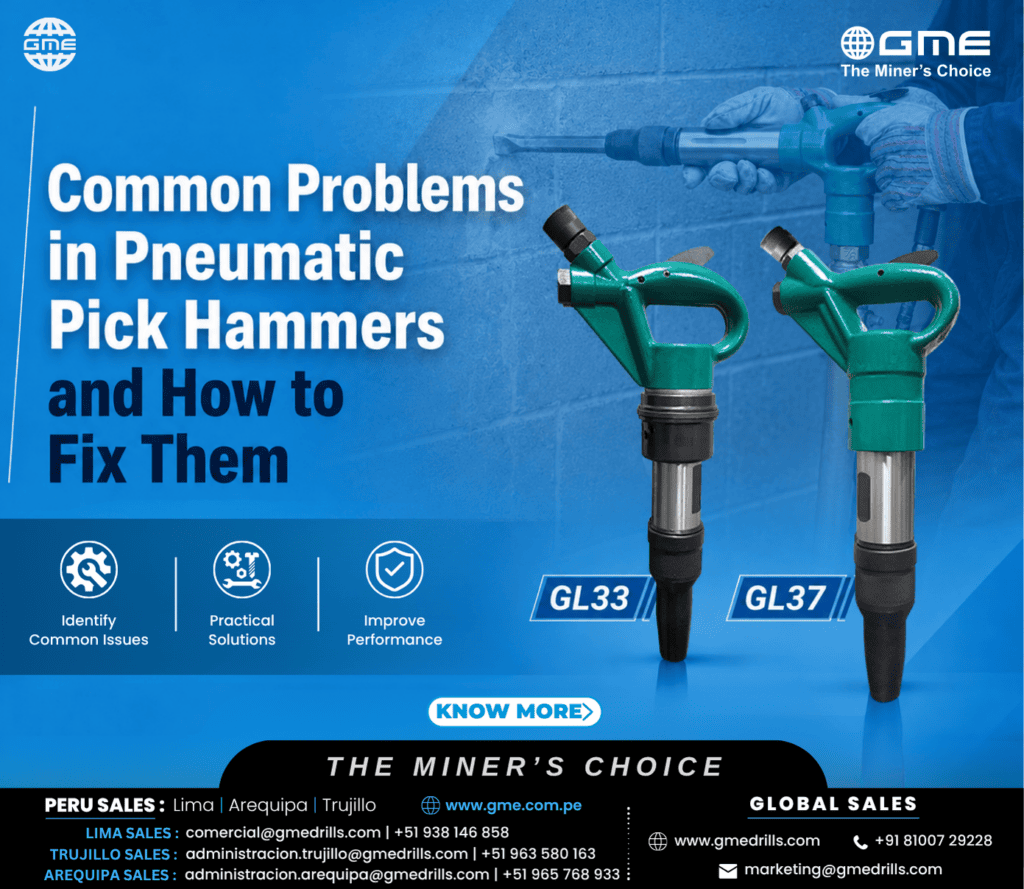
Pneumatic pick hammers are workhorses. Across mining, construction, and heavy-duty drilling applications, tools like the GL33, GL37, GEX12PS, and GEX09P/GEX09PR from GME Drills are relied on to break rock, chip concrete, and power through hard-to-reach spaces shift after shift. But like any high-output tool, they develop problems under sustained load — and when they do, downtime costs money. Here is a straightforward guide to the most common issues and how to resolve them on site.
Product range referenced
GEX12PSLightweight agile pick hammer
GL33D-handle pneumatic, confined spaces
GL37High-impact angular drilling
GEX09P / GEX09PRMaximum impact horizontal drilling
Problem 01
01
Loss of impact power or weak percussion
Likely cause
Insufficient air supply pressure, worn or damaged piston, clogged air passages, or a degraded valve chest. Particularly common in the GL37 and GEX09P/GEX09PR after extended use in abrasive rock environments.
How to fix
Verify that the compressor is delivering the correct operating pressure (typically 90–100 PSI). Inspect and clean all air inlet and exhaust ports. Check the piston and valve chest for wear and replace if tolerance is exceeded.
Problem 02
02
Hammer stops mid-operation
Likely cause
Air hose disconnection, internal valve seizure, or a jammed pick bit. The GL33’s D-handle design makes it especially prone to bit jamming when used in angular or confined positions without proper lubrication.
How to fix
Check all air line connections first. If pressure is confirmed, remove and inspect the pick bit for debris binding. Flush the tool with a short air burst before restarting. Lubricate the bit retainer and recheck valve freedom.
Problem 03
03
Excessive vibration or operator fatigue
Likely cause
Worn anti-vibration mounts, an imbalanced or damaged pick bit, or misalignment between the hammer body and the carrier rig. Common across the GEX12PS in lightweight horizontal applications.
How to fix
Inspect and replace any worn vibration-dampening components. Ensure the pick bit is not bent or chipped — even minor bit damage amplifies vibration significantly. Confirm the tool is seated squarely in the rig mount before operation.
Problem 04
04
Air leaks at connections or body seals
Likely cause
Degraded O-rings, loose fittings, or cracked body seals — all accelerated by heat cycling and high-pressure operation. Audible hissing at the hose connection or around the hammer body is a clear indicator.
How to fix
Apply soapy water around all joints to locate the exact leak point. Replace worn O-rings with manufacturer-specified parts. Tighten all fittings to the correct torque — overtightening can crack threaded ports on the GEX09PR body.
Preventive practice
The maintenance habits that prevent most problems
The majority of field failures in pneumatic pick hammers — whether on the lightweight GEX12PS or the heavy-impact GL37 — trace back to skipped lubrication, incorrect air pressure, or ignored early warning signs. GME Drills builds these tools for durability and minimal maintenance, but “minimal” is not “zero.” A two-minute pre-shift check covering air pressure, bit condition, and connector integrity will prevent the overwhelming majority of mid-shift stoppages.
Field tip
Always use an in-line oiler on your air supply when running any GME pick hammer continuously. It extends piston and valve life significantly, reduces heat buildup in the cylinder, and is the single most cost-effective maintenance action available on site.
When a problem does occur, always diagnose from the air supply inward — most percussion failures originate upstream before they affect the tool itself. GME Drills’ robust construction means the hammer body is rarely the first point of failure; the air system and consumable components almost always are.
Explore the full range
GEX12PS →
GL33 →
GL37 →
GEX09P / GEX09PR →
📞 Ready to upgrade or service your underground drills?
Global Mining Equipments — The Miner’s Choice
Get quote:
📱 +91 8100729228
✉️ marketing@gmedrills.com
🌐 www.gmedrills.com
Keep your drilling fleet strong, efficient, and reliable with proactive care.
GEX12PS
GL33
GL37
GEX09P
Pick Hammer
Maintenance
gmedrills.com